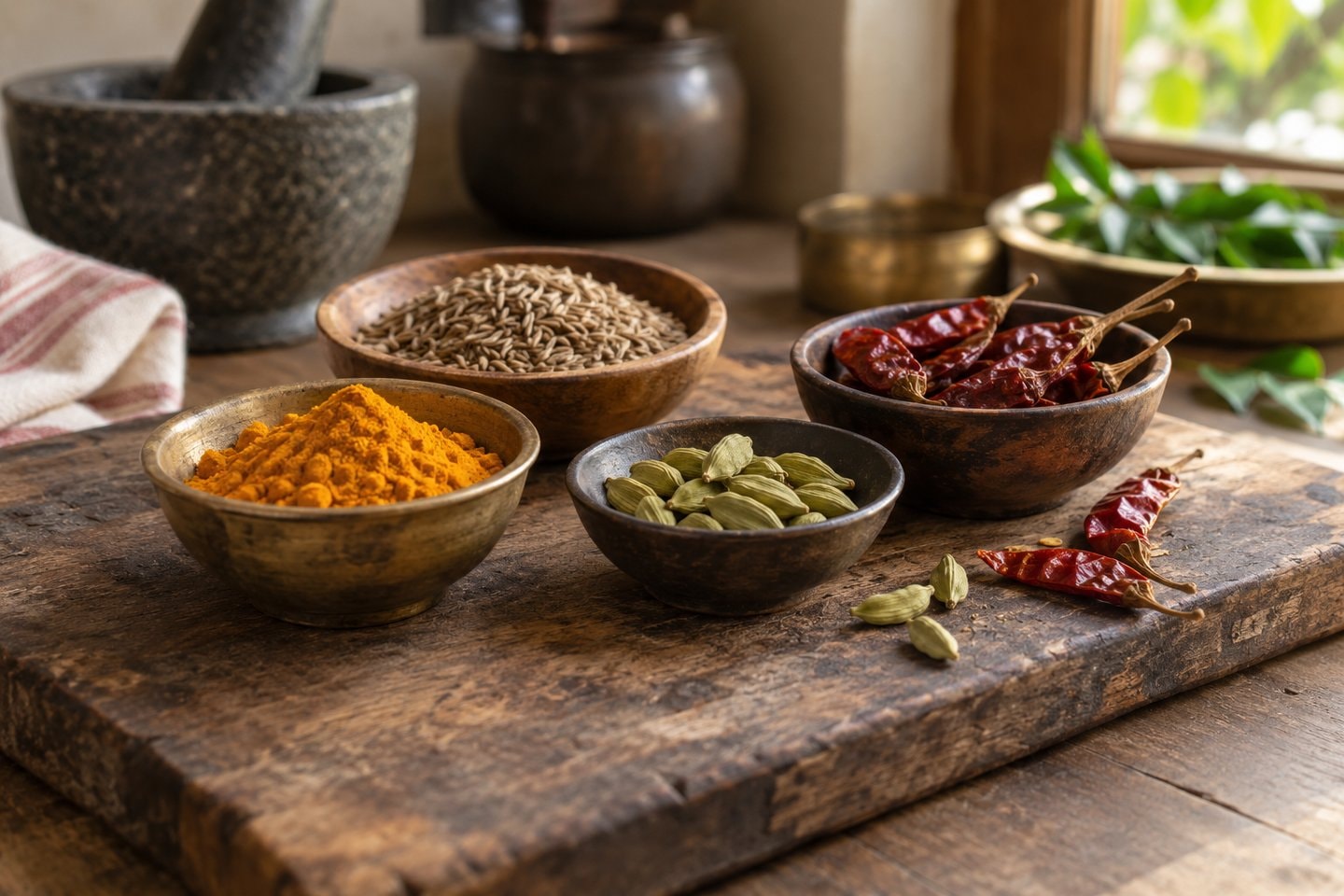
In Ayurvedic tradition, a meal can be described through shadrasa, a vocabulary for its range of flavours. Wikipedia's article on thali names the six tastes as sweet, sour, salty, pungent, bitter and astringent, and describes thali presentation as often including them all. The idea concerns the meal taken as a whole. A dish may contribute to that range without having to contain every flavour itself.
The same article uses thali both for a round platter and for a meal of varied dishes served on it. That double meaning matters here. A plate is an object; a thali meal is an arrangement of foods. The traditional taste vocabulary describes the relationships among those foods, rather than merely the shape of the vessel that holds them.
Reading a varied plate
The thali article describes small bowls around a tray and lists rice, dal, vegetables, roti, yogurt, chutney, pickle and a sweet dish as typical components. It also stresses that dishes vary by region. These descriptions suggest a meal understood through several distinct preparations. A staple can sit beside a pulse dish, a vegetable dish and a condiment, with their different flavours remaining recognisable.
That arrangement gives the traditional classification a practical setting without making it a set of precise cooking instructions. It is possible to describe which kinds of dish appear and how they are presented without specifying quantities. The thali article's account of an ideal meal belongs to Indian food custom and Ayurvedic tradition. It is a cultural account, rather than a promise of an effect on the body.
The vegetarian kitchen guide describes some of the dishes that can appear in such a meal. Their ingredients and textures give a concrete starting point for reading the taste terms. The vocabulary becomes less abstract when rice, yogurt, a chutney and a sweet are understood as distinct foods, each with its own preparation.
The elements behind the vocabulary
Wikipedia's article on Pancha Bhuta describes earth, water, fire, air and aether as the elements of a Hindu cosmological framework. It places the elements within Ayurveda and Indian philosophy, and associates that framework with the traditional account of taste. These are ideas about how a tradition interprets the world. The terms should be read in that philosophical context rather than as a modern chemical analysis of a dish.
In this vocabulary, words such as earth and fire carry their place in a cosmological account. They do not identify ingredients that can be measured from a plate. Keeping that setting explicit is especially useful when moving between a food description and an Ayurvedic text. The account of vata, pitta and kapha explains another set of categories in the same tradition, while retaining their status as traditional concepts.
A festival dish with symbolic meaning
Wikipedia's article on Ugadi describes pachadi as a festive food combining sweet, sour, salty, bitter, astringent and piquant flavours. The article connects the dish with a symbolic expectation of varied experiences in the coming year. Flavour, in this account, becomes a way of talking about life as well as a way of describing a meal.
The article associates jaggery with sweetness, tamarind with sourness and raw mango with astringency in Ugadi pachadi. It also names neem buds or flowers for bitterness, salt for saltiness, and chilli or black pepper for pungency. These details explain the symbolism of the festival dish. They are a description of its traditional ingredients, with no recommendation to use a plant as medicine.
The symbolism is the reason to keep the festival context alongside the flavour words. A general list of tastes does not by itself explain why this particular dish is shared. In the Ugadi article, the mixture evokes happiness, difficulty, surprise and other kinds of experience. That meaning belongs to the account of the celebration, rather than to a universal rule about meals.
How physiology describes flavour
Wikipedia's article on taste distinguishes taste-receptor responses from the larger experience of flavour, which also involves smell, texture and temperature. Its basic taste vocabulary includes sweetness, sourness, saltiness, bitterness and savouriness, also called umami. This is a physiological description of perception, using a different framework from the traditional food classification.
The taste article treats pungency as a sensation involving nerve responses rather than taste buds alone. It describes astringency as a puckering sensation, with examples including unripe fruit and tea. That explains why everyday flavour language can include sensations that are not placed among the same basic tastes in physiology. The word taste is used broadly at the table and more narrowly in a technical account.
Both descriptions can be read carefully without treating their categories as identical. An Ayurvedic classification asks how a tradition groups flavours in an ideal meal. A physiological account asks how sensations are perceived. The page on Ayurvedic eating keeps the first question within its cultural setting, with food discussed as food.
A necessary safety distinction
The National Center for Complementary and Integrative Health states that some Ayurvedic preparations may contain lead, mercury or arsenic in amounts that can be toxic, and advises talking with a health care provider before using Ayurvedic products.