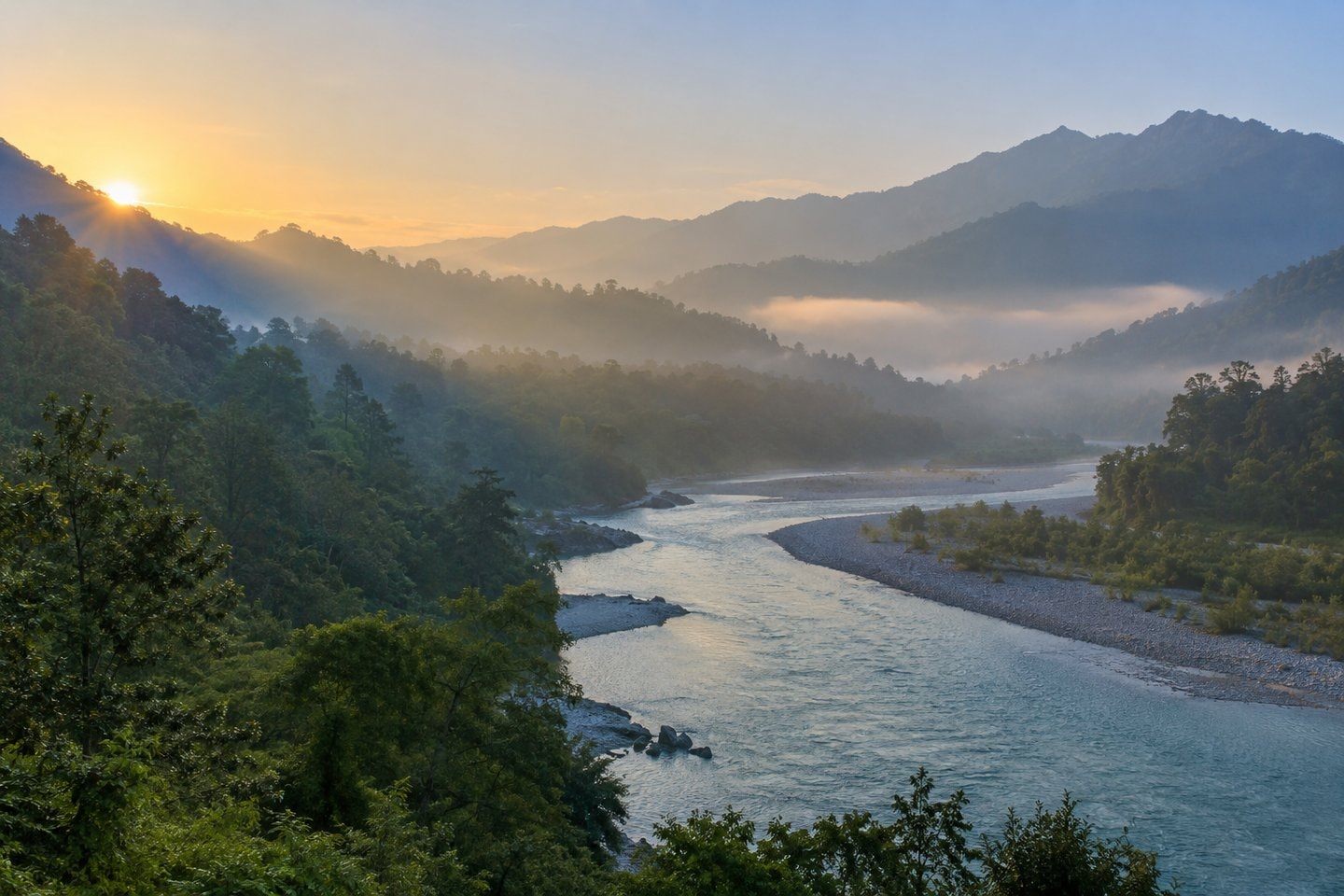
Rishikesh is a place where the geography of a river and the history of spiritual practice meet. Yoga is part of its public identity, but the town has a much broader religious and cultural setting than a visitor might gather from a photograph of a practice room. Its banks hold places of worship and spiritual communities. Its reputation also reaches people who have never travelled to India, through stories about meditation, music and the spread of modern yoga.
Wikipedia’s account of Rishikesh places it on the right bank of the Ganges in Uttarakhand and describes a Hindu pilgrimage town with temples and ashrams along the river. That is a useful starting point: the town belongs to an inhabited landscape and to religious traditions, rather than existing solely as a destination for yoga students. Reading about it means keeping the river, the residents and the spiritual setting in view together.
A river at the edge of the mountains
The Wikipedia article on the Ganges describes the river emerging from its mountain course at Rishikesh before continuing towards the northern Indian plain. The river’s wider course passes through India and Bangladesh. Rishikesh is therefore a particular place along a much larger waterway, not the whole story of the Ganges. Its location makes the movement from Himalayan valleys towards the plain especially clear in an account of the river.
The same reference describes the Ganges as deeply sacred in Hinduism. Geography and religious meaning can be discussed together without confusing them. A river can be described in terms of its course, banks and surrounding terrain, while also being understood through worship and pilgrimage. The religious meaning is part of the traditions of people who live beside it and travel to it. It is not simply a decorative background to the study of yoga.
Rishikesh’s familiar association with the Himalayan foothills also gives context to its reputation as a place of withdrawal and study. The town lies between a mountain landscape and the wider plain. A description of that setting does not need to turn into a list of places to visit. Understanding where the town sits is more useful here than treating the surroundings as an itinerary or a promise of a particular experience.
What the word ashram means
In Wikipedia’s explanation of an ashram, the term refers to a spiritual hermitage or monastery in Hinduism. The article also connects the word with disciplined effort towards a goal. An ashram is consequently more than a building where a person happens to practise postures. The term carries ideas of spiritual purpose, teaching and an organised way of living.
The reference describes traditional ashrams in forests or mountainous places, apart from ordinary settlements, while also noting that contemporary ashrams may be found in populated areas. That distinction matters in Rishikesh, where spiritual communities stand within and around a town. Remoteness is not the defining feature of every ashram. Its role in a tradition and the life conducted there are central to the meaning of the word.
Ashram, retreat and yoga class are therefore different terms, even when they appear together. A retreat describes time set apart; an ashram describes a spiritual institution or hermitage; a class describes a teaching setting. The guide to choosing a yoga retreat explores the questions that follow from those distinctions. No particular institution or teacher is recommended here.
Sivananda and the riverbank
Wikipedia’s biography of Sivananda Saraswati describes him as a Hindu spiritual teacher and proponent of Vedanta, and records his establishment of Sivananda Ashram beside the Ganges near Rishikesh. The historical connection belongs in an account of the town because it shows an ashram as part of a wider body of spiritual teaching. It is a public-record example of the relationship between a place, a teaching tradition and a residential community.
The biography describes yoga in this setting alongside Vedanta and other spiritual subjects. That breadth is a reminder that the word yoga need not mean only physical postures. An account of Rishikesh can acknowledge bodily practice without making it stand for everything taught there. The guide to modern yoga schools and lineages gives a wider context for the different traditions that readers may encounter in yoga literature.
How the town became widely known
Wikipedia’s Rishikesh article associates the town’s International Yoga Festival with its familiar nickname, Yoga Capital of the World. The phrase expresses a reputation; it is not a definition of all yoga or a ranking of places where yoga is studied. The town’s religious life, river setting and ashrams are already part of the account before that public label is considered.
The same Rishikesh article records the Beatles’ visit in February 1968 to Maharishi Mahesh Yogi’s ashram, where their interest was transcendental meditation. It describes songs composed during their stay and later interest from Western visitors. This episode connects the town with popular music and the international attention given to meditation. It does not mean that a musical visit created the town’s spiritual traditions.
Reading the setting respectfully
A respectful account leaves room for meanings beyond a visitor’s interests. Pilgrimage, worship, residential study and modern postural practice can share a place without becoming interchangeable. Terms such as ashram and meditation have histories of their own. A photograph or a nickname gives only a partial view; a fuller reading considers the community and tradition that give a place its significance.
The yoga calendar puts the festival alongside other ways that yoga and related traditions mark the year. It is a cultural guide, with no event notices or travel recommendations. Rishikesh can be understood through that broader setting: a town beside the Ganges, a place of spiritual institutions, and a name that has travelled widely through accounts of yoga and meditation.